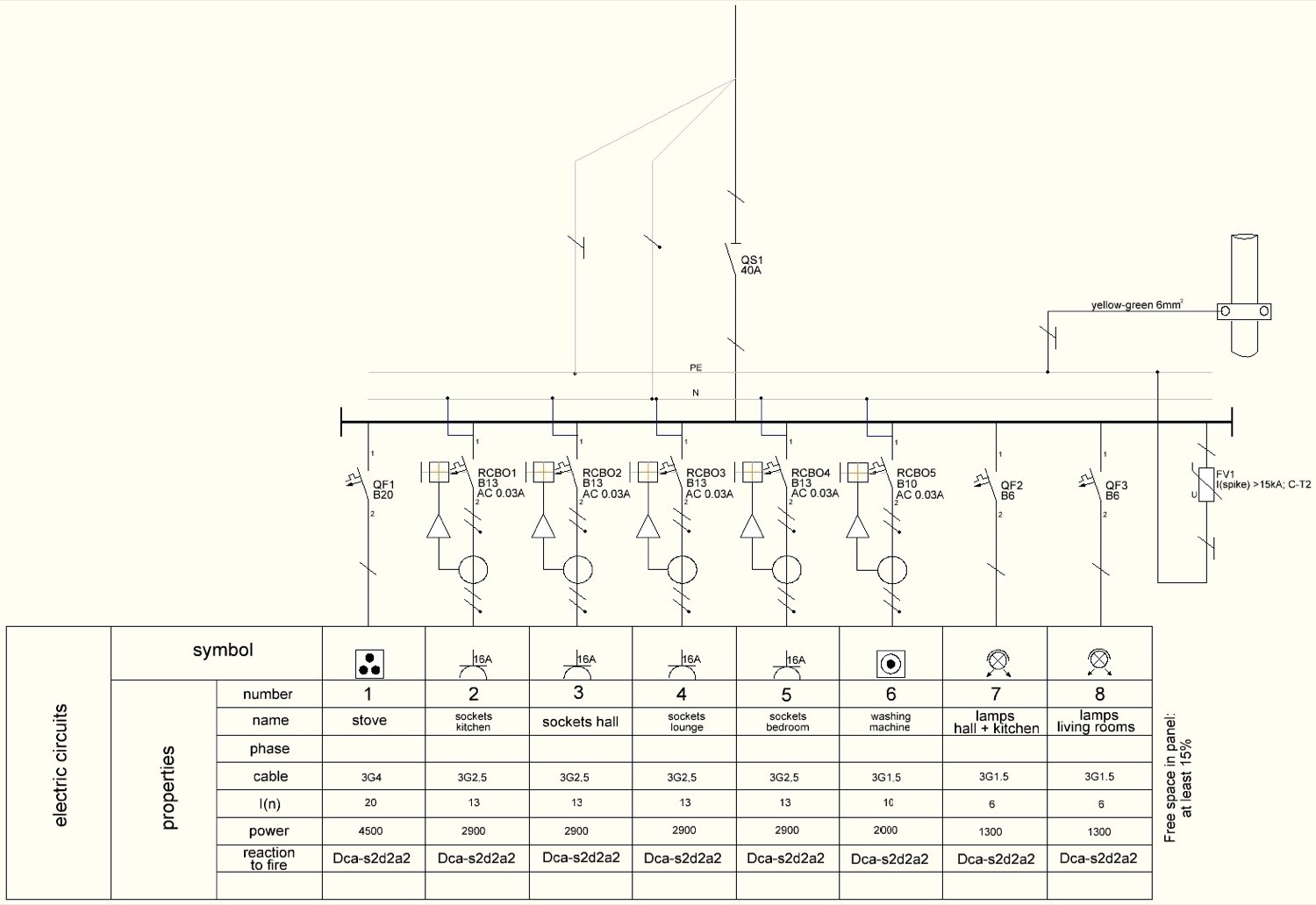
A compliant PV single-line diagram has to show the full electrical path from the modules to the point of interconnection: the array with its module and string counts, the inverter, every DC and AC disconnect, conductor and overcurrent (OCPD) ratings, the grounding and bonding scheme, and the rapid-shutdown method. It is the drawing an authority having jurisdiction (AHJ) reads to confirm the system meets the National Electrical Code (NFPA 70), so missing ratings, undefined disconnects, or an unclear interconnection point are what get plans corrected.
Key takeaways
- A single-line traces the whole electrical path, from modules to the point of interconnection, on one page.
- Show the specifics: module and string counts, inverter model, conductor sizes, and OCPD ratings, not just block shapes.
- Every DC and AC disconnect, plus the grounding and bonding scheme, has to be drawn and labeled.
- Rapid shutdown under NEC Article 690 is a required element, not an afterthought.
- Missing ratings and an undefined interconnection point are the omissions that reliably fail plan check.
- Why your single-line keeps drawing corrections
- What a PV single-line diagram actually is
- The DC side: modules, strings, and inverter input
- The inverter and the AC side
- Disconnects, conductors, and overcurrent protection
- Grounding, bonding, and the point of interconnection
- Rapid shutdown and the labels reviewers want
- Element by element: what to show, how it gets corrected
- A single-line diagram checklist
- Single-line omissions that fail plan check
Why your single-line keeps drawing corrections
A plan-check correction is rarely about the whole design being wrong. It is almost always about one thing the reviewer could not confirm from the drawing in front of them. The single-line diagram is where those confirmations live, so it is where the red ink lands. If a rating is missing, a disconnect is undefined, or the interconnection point is vague, the reviewer cannot sign off, and the plan goes back.
The frustrating part is that a resubmittal often changes almost nothing. You add a conductor size you already knew, or you label a disconnect that was always in the design. The information existed. It just was not on the page in the form the AHJ needed to read it. That gap between what you know and what you drew is the whole problem, and it is fixable once you know what reviewers are scanning for.
AHJs read the single-line against the National Electrical Code, and a growing number of jurisdictions now run the same checks through automated permitting. The U.S. Department of Energy reports that more than 160 communities have adopted SolarAPP+, an automated tool that reviews residential PV designs for code compliance (DOE, 160 Communities Automating Permitting). Whether a human or software does the review, the drawing has to answer the same questions.
What a PV single-line diagram actually is
A single-line diagram, also called a one-line, is a simplified electrical drawing that represents the whole PV system as one continuous path, even though the real circuits carry multiple conductors. It uses one line to stand in for a set of conductors and standard symbols for each device. The point is not to show every wire. The point is to show the system logic so a reviewer can follow current from the array to the grid and check protection at each step.
Think of it as the electrical story of the project on a single page. It names the equipment, sizes the conductors, places the disconnects and overcurrent devices, and defines where the system ties to the building and the utility. The DOE frames automated permitting review around exactly these code-compliance questions, which is why the one-line carries so much weight in the packet (DOE, Streamlining Solar Permitting with SolarAPP+).
Because it is a code document, the National Fire Protection Association's NFPA 70 sets the rules it has to satisfy. The NFPA describes the code this way.
The NFPA presents NFPA 70, the National Electrical Code, as the widely adopted benchmark for the safe installation of electrical wiring and equipment, and that benchmark is the standard a PV single-line diagram is drawn to meet.
NFPA 70 (National Electrical Code)
The DC side: modules, strings, and inverter input
The one-line starts at the array. A reviewer wants to see the module make and model, the total module count, and how those modules group into strings. Show the number of strings and the modules per string, because that is what sets the DC voltage and current the rest of the system has to handle. A block labeled "PV array" with no counts tells the reviewer nothing they can check.
String configuration matters because voltage climbs on cold days and current is driven by irradiance and temperature together, so the array's rated values feed directly into conductor and device sizing (DOE, Solar Performance and Efficiency). The single-line should carry the maximum system voltage and the calculated string current so every downstream rating can be traced back to a source.
If the system uses module-level electronics, say so on the drawing. Microinverters and DC optimizers change where conversion and rapid shutdown happen, and a reviewer needs to know whether they are looking at a string system or a module-level one before they can judge anything else. The DC section should make that architecture obvious at a glance.
The inverter and the AC side
The inverter is the hinge of the drawing, where DC becomes AC. Name the specific inverter model and show its ratings, including the AC output current and voltage. This is not a place for a generic box. The inverter's listed output current is the number a reviewer uses to size the AC conductors and the overcurrent device that follows it, so the model has to be identified.
From the inverter, the AC path runs through its disconnecting means toward the point of interconnection. Show the conductors on that run with their size and type, and show the overcurrent protection that guards them. If there is a subpanel, a production meter, or an AC combiner between the inverter and the service, each of those belongs on the line in sequence. The reviewer is following current, and any gap in the sequence reads as a missing device.
Keep the AC side and the DC side visually distinct. Mixing them, or leaving it unclear which conductors are DC and which are AC, forces the reviewer to guess, and reviewers do not sign off on guesses.
Disconnects, conductors, and overcurrent protection
This is the section where most corrections cluster, because it carries the most numbers. Every disconnecting means has to appear on the single-line, both DC and AC. That means the inverter's integrated DC disconnect, any standalone DC disconnect, the AC disconnect, and the utility-required disconnect where the local rules call for one. Each should be labeled so the reviewer knows what it isolates.
Conductors need size and type at each segment: the string conductors, the inverter output conductors, and the conductors at the interconnection. Overcurrent protection needs a rating wherever the code requires it, including fuses in a DC combiner and the breaker at the point of interconnection. The single-line is where the reviewer confirms that each conductor is protected by a device sized correctly for it under the NEC.
The rule of thumb that saves resubmittals is simple. If a device carries or interrupts current, it needs a rating on the drawing. A disconnect with no ampere rating, or a conductor with no size, is an open question, and open questions come back as corrections.
Grounding, bonding, and the point of interconnection
Grounding and bonding are code requirements, so the single-line has to show the scheme, not imply it. Show the equipment grounding conductors, the grounding electrode connection, and how the array frames and racking are bonded. A reviewer confirming NEC compliance needs to see that the system has a defined path to ground and that metal parts are bonded, and the National Electrical Code is the standard that path is judged against (NFPA, Understanding NFPA 70).
The point of interconnection is where the PV system connects to the building's electrical service and, through it, to the utility grid. The drawing has to define this point exactly, because it determines whether the connection is a supply-side or load-side tap and whether the busbar can handle the added current. Show the main service rating, the main breaker, and the busbar rating, and show where the PV breaker lands in the panel. An interconnection drawn as a vague arrow into a service is one of the fastest ways to earn a correction.
Label the interconnection with enough detail that the reviewer can run the busbar calculation from the drawing alone. If they have to ask what the busbar rating is, the answer arrives as red ink instead of an approval.
Rapid shutdown and the labels reviewers want
Rapid shutdown is a safety function that lets first responders de-energize conductors on and near the array, and it is required for most rooftop PV under NEC Article 690. The single-line has to show how the system achieves it, whether through module-level devices, a string-level shutdown box, or an inverter with the function built in. A drawing that never mentions rapid shutdown is missing an element the reviewer is specifically trained to look for.
Along with the shutdown method, show the initiation device and where it sits, since responders need a defined way to trigger it. Labeling is part of this too. The code requires markings and placards for PV systems, and while the physical labels live on the equipment, the single-line and its notes are where the plan set documents that they exist. The NEC is the framework that defines these requirements (NFPA).
Rapid shutdown ties back to the DC architecture you named earlier. A module-level system usually satisfies the array boundary requirement through the module electronics, while a string system needs a dedicated method. Draw the one you are actually using, and make the connection to the array explicit.
Element by element: what to show, how it gets corrected
This table maps each required element to what the drawing has to carry and the correction that shows up when it is missing. Use it as a quick cross-check before you submit.
| Element | What the single-line must show | Common correction when missing |
|---|---|---|
| PV array | Module model, total count, strings and modules per string | "Identify module and string configuration" |
| Inverter | Specific model with AC and DC ratings | "Provide inverter make, model, and ratings" |
| DC and AC disconnects | Every disconnecting means, labeled with ampere rating | "Show and rate all disconnecting means" |
| Conductors | Size and type at each segment, DC and AC | "Specify conductor size and type" |
| Overcurrent protection | OCPD rating wherever the code requires it | "Provide overcurrent device ratings" |
| Grounding and bonding | Grounding electrode, EGCs, array bonding path | "Detail equipment grounding and bonding" |
| Point of interconnection | Service, main breaker, busbar rating, PV breaker location | "Provide busbar and interconnection calculation" |
| Rapid shutdown | Method, initiation device, array boundary compliance | "Show rapid-shutdown method per Article 690" |
None of these are exotic. They are the fields a reviewer or an automated tool checks on every submittal, which is why leaving one blank is such a reliable way to lose a week (DOE).
A single-line diagram checklist
Run this before the plan set leaves your desk. It catches the omissions that force a resubmittal.
- Module make, model, total count, and strings with modules per string are shown.
- Maximum system voltage and calculated string current are on the drawing.
- The specific inverter model appears with its AC and DC ratings.
- Every DC and AC disconnect is drawn and labeled with an ampere rating.
- Each conductor segment carries a size and type, DC and AC kept distinct.
- Overcurrent devices have ratings everywhere the code requires them.
- The grounding electrode, equipment grounding conductors, and array bonding path are shown.
- The point of interconnection names the service, main breaker, and busbar rating.
- The rapid-shutdown method and initiation device are shown per NEC Article 690.
- Required PV labels and placards are noted on the plan set.
Single-line omissions that fail plan check
The corrections below repeat across jurisdictions. Each one traces back to information that existed in the design but never made it onto the page in a form the reviewer could confirm.
Generic equipment blocks with no ratings
A box labeled "inverter" or "disconnect" with no model and no ampere rating is the most common miss. The reviewer cannot size anything downstream from a blank, so it comes back. Name the device and rate it.
An undefined point of interconnection
An arrow pointing into the service panel without a busbar rating or breaker location forces the reviewer to request the interconnection calculation. Show the service rating, the main breaker, the busbar rating, and where the PV breaker lands.
Missing conductor sizes
Conductors drawn as plain lines with no size or type leave the protection scheme unverifiable. Every segment needs a size so the reviewer can confirm the OCPD matches it.
No rapid-shutdown method
A rooftop system that never shows how it meets Article 690 is an automatic correction. Draw the shutdown method and the initiation device, and tie them to the array (NFPA).
Grounding left implied
Grounding and bonding are required, so a drawing that assumes them instead of showing the path gets flagged. Draw the electrode connection, the grounding conductors, and the array bonding.
The pattern behind all of these is redrawing the same information a second time under a deadline. This is where design software pays for itself. PVCAD, an AutoCAD plugin, generates single-line diagrams and NEC-compliant construction documents with wire sizing for projects up to about 5 MW, so the conductor sizes, ratings, and one-line are produced from the design itself rather than filled in by hand. When the ratings come from the same model that laid out the system, the blanks that trigger corrections do not get left behind. Automated permitting is expanding for the same reason, since consistent, complete drawings are what let a review, human or software, close on the first pass (DOE).
Frequently asked questions
What is a single-line diagram for solar?
A single-line diagram, or one-line, is a simplified electrical drawing that shows the whole PV system as one continuous path, from the modules through the inverter and disconnects to the point of interconnection. It uses one line to represent a set of conductors and standard symbols for each device, and it is the drawing an AHJ reads to confirm the system meets the National Electrical Code (NFPA).
What does a PV one-line need to show?
It has to show the array with module and string counts, the specific inverter, every DC and AC disconnect, conductor sizes and types, overcurrent device ratings, the grounding and bonding scheme, the point of interconnection, and the rapid-shutdown method. These are the same code-compliance elements automated permitting tools check, so a blank in any one of them tends to draw a correction (DOE).
Why do AHJs reject solar single-line diagrams?
Most rejections come from information the reviewer cannot confirm: a disconnect with no ampere rating, a conductor with no size, a vague point of interconnection, or a missing rapid-shutdown method. The design is often fine, but the drawing does not carry the specifics the AHJ needs to sign off. Whether a person or an automated tool reviews it, the same questions have to be answered on the page (DOE).
Is rapid shutdown required on a solar single-line diagram?
Yes for most rooftop PV. Rapid shutdown is required under NEC Article 690, and the single-line has to show how the system achieves it, through module-level devices, a string-level shutdown box, or an inverter with the function built in, along with the initiation device. A drawing that never addresses it is a reliable correction (NFPA).
What is the point of interconnection on a solar one-line?
It is where the PV system connects to the building's electrical service and, through it, to the utility grid. The one-line has to define it exactly, including the service rating, main breaker, busbar rating, and where the PV breaker lands, because that determines whether the connection is a supply-side or load-side tap and whether the busbar can carry the added current. An undefined interconnection point forces the reviewer to request the calculation (DOE).
Can software generate a solar single-line diagram?
Yes. PVCAD, an AutoCAD plugin, generates single-line diagrams and NEC-compliant construction documents with wire sizing for projects up to about 5 MW, so the conductor sizes and device ratings come from the design instead of being filled in by hand. Producing the one-line from the model helps keep the blanks that trigger corrections off the page (DOE, SETO).
Sources
- NFPA - Understanding NFPA 70 (NEC)
- NFPA 70 (NEC) product page
- DOE - Streamlining Solar Permitting with SolarAPP+
- DOE - 160 Communities Automating Permitting with SolarAPP+
- DOE - Solar Energy Technologies Office
- DOE - Solar Performance and Efficiency
- DOE - Homeowner's Guide to Going Solar
- PVComplete - PVCAD